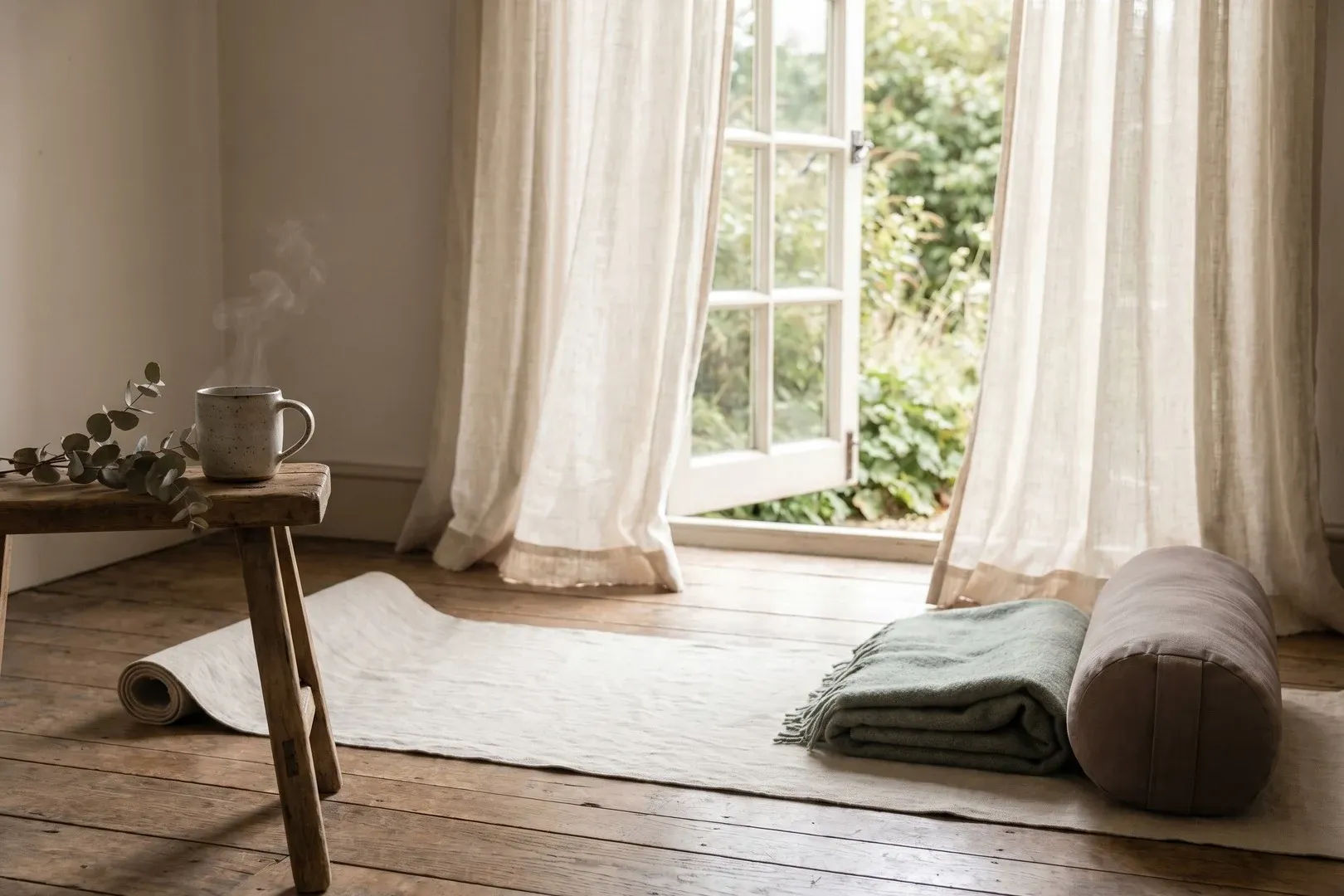
Slow Hatha Yoga reduces chronic stress and anxiety by training the nervous system to settle, not by providing temporary relief. Holding postures long enough, with sustained attention, gradually shifts the habitual patterns that keep the mind in a state of anxiety. This works differently from most relaxation approaches because the body is actively involved in calming the mind. The post explains the mechanism and the case for Hatha specifically, over faster styles.
1. We are stuck in a busy world
We live in a busy world: there is a constant sense of urgency; there is always something to be done; we have to juggle multiple tasks, and our attention jumps from one thing to another.
The problem is that we are, as much as we might not immediately believe it, addicted to being busy. Even when we happen to have some spare, quiet time, we mindlessly scroll our social media page, and let our attention jump yet again from one thing to another, one post to another. Busy, even when doing nothing. So it never stops.
This is pretty much our daily state of mind. So we say “hey, life is hectic; there are lots of pressures, and we have so many things to do and manage” and often we don’t see we have a choice.
But what if instead of catching up with (like that ever happens!) our Facebook stream on our lunch break, we were told to just sit and do nothing? Would we? It seems like the most impossible thing. I cannot switch off, my thoughts are bombarding me, I feel like I’m wasting my time, I’d rather DO something. ANYTHING!
2. We are creating a vicious circle
It feels that we don’t have a choice because we are addicted to this hectic, busy state of being. And even when we notice how stressed we are (perhaps we develop a health condition due to anxiety) and we acknowledge that something needs to be changed, we are still addicted to the chemicals our brain is habitually producing. And we create more situations to keep us in this state of mind; this is a truly vicious circle. In order to break it and release our anxiety, we have to acknowledge that it might feel uncomfortable, and difficult, in the same way as if we were dealing with an addiction. We need to withdraw. But we must commit to unwinding, and to slowing down.
3. Holistic therapies
This is such a common problem nowadays that the number of wellness businesses is growing. There are many wonderful holistic therapies to help people unwind, to connect to a state of rest and calm, and to regulate the autonomic nervous system, so they may regain balance. But even when having a massage, can you truly relax? Or are you chatty, or critical, or thinking about later that day?
Many people benefit greatly by regularly scheduling holistic treatments; however, as a holistic therapist myself I observe that those with anxiety, who arguably need this the most; most often don’t schedule (or incline towards chatting!). Something which is so enjoyed by so many people is often outside the comfortable zone of those with anxiety.
Of course there is a way to work with this, and in fact some modalities, such as Craniosacral Therapy, are great for addressing these issues. I’m going to focus on how this works in a future article.
Whichever modality you choose for healing, it will always be important to take responsibility for your own health, in your own hands, and do your bit first. So why not learn how to unwind and slow down, and to be more in charge of the state of your own mind first?
4. Learn to unwind and slow down
So how can we start?
Take time daily to stop, unwind, and be present. Feel the wind on your face, hear the sound of the wind. Observe what is, and appreciate it. Difficult? Yes, to begin with, but that’s where body & mind activities such as Yoga and meditation are very helpful.
Yoga and meditation are like two sides of the same coin. Yoga as we know it in “the West” involves our physical body, but what makes the difference between a Yoga and an exercise class is that in Yoga we involve the attentiveness and engagement of our mind. The more attentiveness and awareness we develop, the more our Yoga practice becomes a meditation. Therefore, we could say that meditation is an effect, or an advanced stage, of Yoga. And often we find it easier to start with Yoga practice, and gradually graduate into meditation.
Some people who realise they need more clarity of mind are attracted to meditation initially, often perceiving Yoga as just a physical exercise that they might not be interested in. For some, this path might be more difficult, but for those truly committed it might in fact be more direct.
Whatever path you choose, you cannot skip mindfulness, attentiveness, and being in the present moment.
To start with a Hatha Yoga practice is considered the easiest path, because the Yoga asanas (body postures) help to create and support certain states of mind. By practising these postures, becoming more comfortable and at ease in them, a certain degree of mindfulness develops, our awareness naturally settles at certain energy centres, and the process becomes less of a struggle. Before we realise, there is a shift in our mind, our consciousness expands, and we enter meditation.
All those times that you felt like a Yoga class passed almost in a second (assuming you didn’t fall asleep!) you most likely entered an expansive state of mind, which we could call meditation.
5. What type of yoga is best for anxiety and stress
For people with anxiety and chronic stress, and especially those who find it difficult to switch off, I would recommend starting with Hatha Yoga, to receive some support from the body postures in settling your mind. The Yoga postures need to be held for enough time to expand the awareness from the body to more subtle levels. The fast, dynamic, more recently developed Yoga styles will not address the problem of your mind. You might feel fantastic afterwards, especially if you are already fit and flexible and you like a physical workout, but it won’t teach your mind to slow down, and to get used to being still and at ease.
If you want to see effects on your mind, and address problems of anxiety, you have to work towards a slowing down of mental activity. The challenge shouldn’t be to enter the posture, but to hold it in a relaxed and comfortable way for a longer and longer time. The Yoga Sutras, Yoga’s seminal text written by Patanjali, says Yoga asanas should be practised in a steady and comfortable manner; and that when the shift in the mind happens, every passing thought will quieten down, and a new restful state of mind will emerge.
6. Bring yoga from the mat to your daily life
If that wonderful state happens several times, it will become easier and easier to induce it with even a short practice at home, and eventually you might even be able to invoke it by will alone, in the middle of a busy day. At that point, we have control of our minds and can self-regulate the nervous system.
It’s not about quitting everything which might potentially create some stress, or not having goals and ambitions. We are well-enough equipped to discharge our stresses, but to do so the autonomic nervous system has to be healthy and balanced.
And I cannot think of a better vehicle for achieving this than via Yoga and meditation.
If this resonates, my weekly Hatha Yoga classes run across mid-Norfolk, and a one-to-one is often the kindest way to start when anxiety is loud. If something deeper is driving the pattern, Craniosacral Therapy at Honingham can sit alongside the practice. Drop me a line if you’d like to talk it through.
